
e1RMs aren't valid, but you should use them anyway
Performance measures are good, even if they're not very accurate

It’s not my most controversial powerlifting take, but certainly one that’s not unanimous - estimated 1RMs are extremely useful, and as a coach I look at them basically religiously.
I definitely understand the arguments against not using them (not particularly accurate, different for different lifters, can estimate where someone’s top end is by Eye Tendo™, etc) however all of these pale in comparison to the fact that knowing if someone is getting stronger without having them max out is useful.
What I’m Looking For
It’s useful to be able to know if someone is getting stronger for a sport that cares about strength1 but there’s a few additional properties that are good.
Doesn’t affect programming. I want to be able to program the way that I think is best, without having to also add in some measure of strength gain. (This is my big complaint about explicit indicator sets.)
Can be done quickly and easily. I want to be able to do this for every athlete, weekly or per session. I don’t want to have to wait until the end of a block (or worse, several blocks) before knowing if a change worked or not.
Can be compared between different stages of training and over large periods of time.
Needs to be reasonable internally accurate.
As far as I can think of, there’s only really 2 measures that work here - e1RM (based on RPE, sets, and reps2), or v1RM (velocity based formula.)
Here’s the thing - e1RMs don’t need to be especially accurate to be useful. I’m not looking at the number getting popped out of the formula and immediately planning to load it on the bar. What I am doing is looking at week-to-week and block-to-block changes to see if performance is changing the way we would expect.
Let’s look at a specific example - we’ll call this person Lifter A, and this is her bench press performance since the beginning of June.
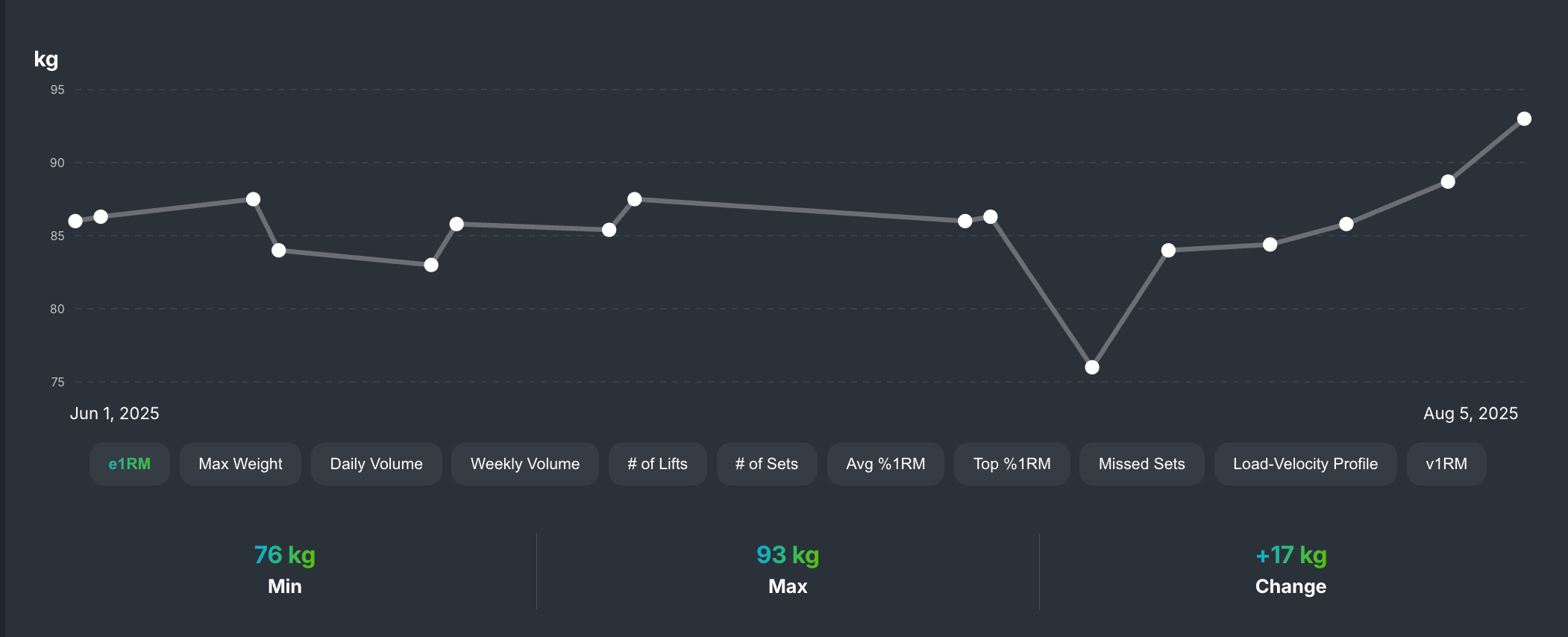
The peak e1RM (right hand side) is 93 kg. I’m not going to load 93 kg on the bar for her (or even 92.5 kg) just because that’s what the graph says. What I can do is compare what we were doing before and what we are doing now, to see if it’s working or not.
It becomes much more obvious when we seperate it out by block.
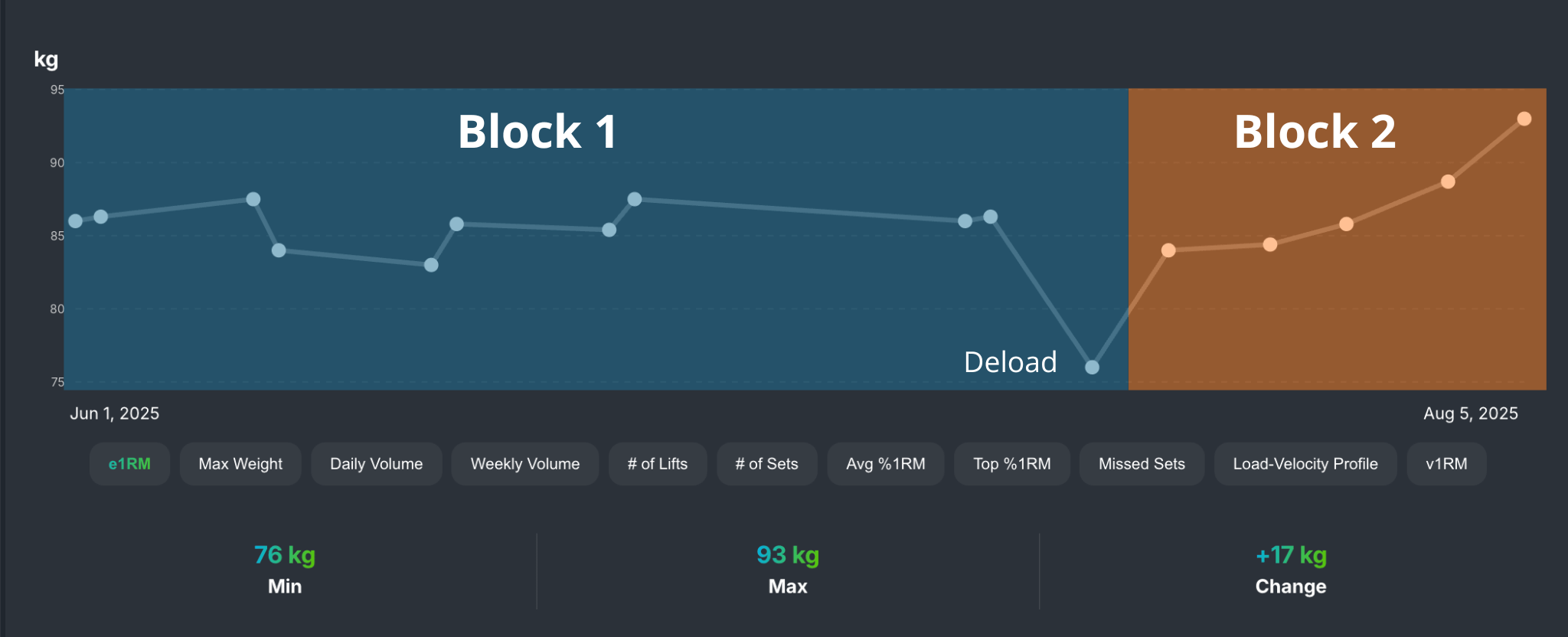
We can see here that Block 1 was… kind of mediocre. Performance was fairly static, there were a couple of missed sessions, and even ignoring the deload (labelled) performance at the end of the block was basically the same as at the beginning3. Not awesome.
In comparison, the new block has seen improved performance every session.
Now this could bring up a bunch of new questions4, but without having some meaningful way to compare the efficacy of these training blocks, I wouldn’t even know I needed to ask them. In fact, without a meaningful way to compare week-to-week or session-to-session, I may not have noticed that the first block wasn’t working, or may have attributed that to the missed sessions (even though it was obvious even before then.)
Improvements to e1RM
None of this is to say e1RMs are perfect, or even useful without context.
One thing that bugs me a little about e1RMs is that there’s no good way to calibrate the formulae to individuals today - it should be possible to use a minimal number of data points to refine some parameter to make the actual number that’s output much closer to reality5.
1RM = weight × (1 + 0.0333 × reps)6
Even without making the formula substantially more complex, it should be possible to tune the parameter (0.0333) to some more specific, individualised (or lift-specific) number based on as few as 2 data points (more realistically, a small handful.)
That said, even if I did, I’m not sure that it would change my approach here. I would still monitor for week-to-week changes, I would still compare block-to-block to see if we’re head in the right direction, and I would still use my best judgement come meet day on what number to load on the bar, regardless of what the formula says.
Are you using e1RM or some other performance measure to estimate if you’re heading in the right direction or not? What are you using? What other improvements would you like to see made?
Duh.
I’m mentally adding error bars here - the actual numbers are 86.0 kg and 86.3 kg. Not enough to write home about.
What change made this happen? Is it repeatable? Did something from the first block potentiate something in the second block? How much of an improvement is noteworthy? We haven’t finished the block yet; will this trend last out the whole block?
I may have just reinvented v1RM.
This is the Epley Formula